A wave of concern has quietly emerged inside the organization of the Toronto Blue Jays after reserve infielder Davis Schneider broke his silence on what has been a frustrating and emotionally draining season in 2026. While the season continues on the field, something far more personal appears to be unfolding behind the scenes — a growing sense of doubt from a player struggling to find his place.
For much of the year, Schneider has remained one of the least-utilized players on the roster, watching games unfold from the dugout rather than contributing on the field. But in a rare and candid moment, he finally addressed the emotional toll of that reality, offering a glimpse into the mental strain that often goes unnoticed in professional sports.
“I’ve tried every single day, but the opportunities are still very limited,” Schneider reportedly said. “There are moments when I look at the field and wonder if I’m truly good enough to be here.”

The statement, simple yet heavy, quickly circulated among fans and analysts, many of whom were surprised by the raw honesty from a player still fighting for consistent playing time.
According to team insiders, Schneider has remained professional throughout the season despite his limited role. Coaches have reportedly praised his work ethic in training sessions, noting that he continues to prepare as if he were a starter. However, preparation alone has not translated into meaningful game time, and that disconnect appears to be taking a psychological toll.
What makes Schneider’s situation particularly compelling is not just the lack of playing time, but the internal conflict it seems to have created. In the same emotional reflection, he admitted that the hardest part is not sitting on the bench — it is the feeling of being unable to break through despite relentless effort.
“The biggest disappointment isn’t not playing,” he added. “It’s the feeling that no matter how hard I try, I can’t seem to take that next step forward.”
Those words have sparked a broader conversation within baseball circles about the mental challenges faced by role players in highly competitive environments like Toronto. Unlike everyday starters who have clear routines and consistent roles, bench players often live in a constant state of uncertainty — never fully knowing when or if their opportunity will come.
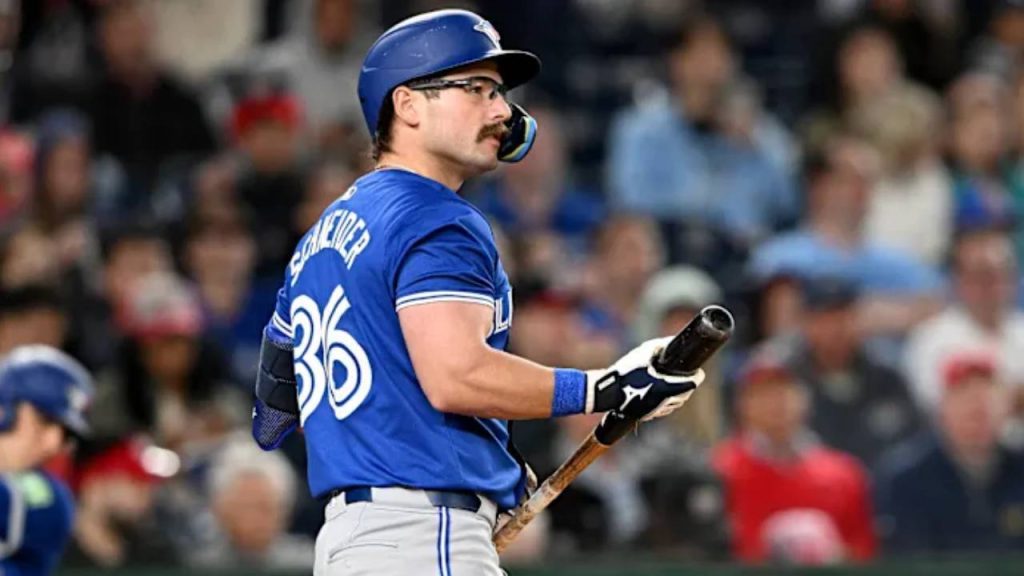
Inside the clubhouse, sources describe Schneider as someone who has remained respectful and supportive of teammates, even while dealing with personal frustration. One team staff member reportedly described him as “quietly competitive,” someone who channels disappointment into preparation rather than confrontation. Still, the emotional weight of his situation appears to be building.
The Blue Jays, meanwhile, continue to navigate a demanding season with high expectations from fans and management. Every roster decision is scrutinized, every lineup change analyzed. In such an environment, breaking into the regular rotation becomes increasingly difficult, especially for younger or fringe players trying to establish themselves.
For Schneider, that challenge now appears to be as mental as it is physical.
Baseball analysts note that his situation is not uncommon, but the openness of his comments is what makes this moment stand out. Players in similar positions often remain silent, choosing to internalize frustration rather than express it publicly. Schneider’s willingness to speak candidly suggests a level of emotional pressure that can no longer be ignored.
Fans have reacted with a mixture of sympathy and concern. Many have taken to social media to encourage the young infielder, emphasizing that development in Major League Baseball is rarely linear. Others, however, have pointed out that roster competition at this level is unforgiving, and opportunities must be earned repeatedly in limited chances.
Within the organization, there has been no official response to Schneider’s comments, though internal discussions are believed to be ongoing regarding player development and depth management. Coaches are reportedly aware of his frustration but remain focused on team performance as the season progresses.
Still, moments like this often serve as turning points — either quietly reshaping a player’s trajectory or signaling a difficult crossroads ahead.
For Schneider, the path forward remains uncertain. His talent has never been in question, but opportunity is a different challenge entirely — one that depends on timing, team needs, and performance windows that can close as quickly as they open.
As the Blue Jays continue their 2026 campaign, Schneider’s emotional admission now lingers as an undercurrent beneath the daily rhythm of the season. It is a reminder that behind every lineup card and stat line, there are players wrestling with doubt, ambition, and the constant pressure to prove themselves.
And as he left reporters with one final thought — unfinished, unresolved — it became clear that this story is far from over. The question now is not just when his next opportunity will come, but what he will do with it if it finally arrives.